
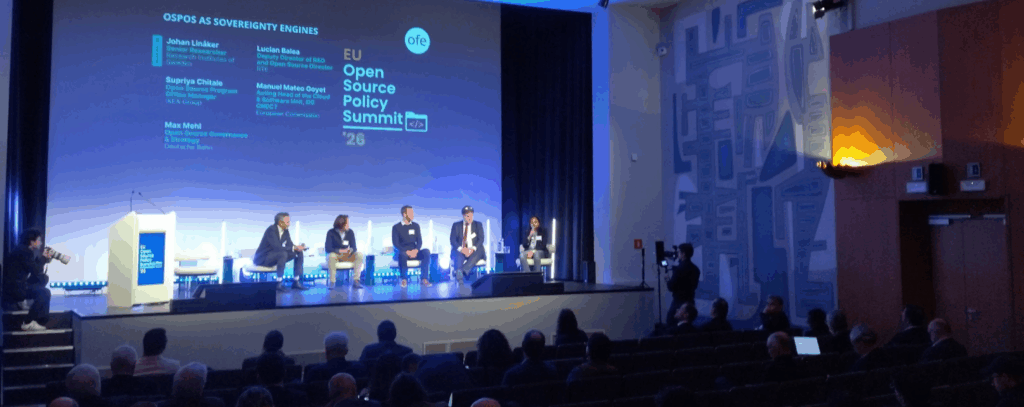
On 30 January 2026, the HIGHER Project had the privilege of attending the EU Open Source Policy Summit 2026, hosted by OpenForum Europe in Brussels, Belgium — the premier European forum that brings together policymakers, industry leaders, researchers, and open source advocates to shape the digital future of Europe.
Aligned with this year’s theme, “Digital Sovereignty Runs on Open Source”, the Summit offered a unique platform for high-level discussions on how open source and open technologies can underpin a sovereign, resilient, and competitive European digital ecosystem.
“EU Open Source Policy Summit 2026 – Digital Sovereignty Runs on Open Source”
Open Source as a Strategic Foundation for Europe
The Summit underscored a fundamental message that resonates with the HIGHER Project’s mission: to advance open, heterogeneous, and resilient computing infrastructures across cloud, edge, and HPC environments. Throughout the day’s sessions, speakers and panels explored how collaborative innovation models, rooted in openness and shared development, are critical to strengthening Europe’s digital sovereignty, competitiveness, and strategic autonomy.
Keynote addresses from European Commission representatives and industry leaders framed open source not merely as a development approach, but as a strategic enabler of innovation, interoperability, and long-term capability. These insights resonate directly with HIGHER’s work on enabling open standards, flexible compute architectures, and layered abstraction models that bridge heterogeneous computing domains across the European research and technological landscape.
Some highlights from the Summit
Several sessions were especially relevant to HIGHER’s objectives:
-
Open Source & Economic Security: discussions focused on how open source contributes to economic resilience by reducing dependency on proprietary systems and fostering interoperable public infrastructure — a key pillar in building sovereign computing ecosystems.
-
OSPOs as Sovereignty Engines: the role of Open Source Programme Offices (OSPOs) was examined as a mechanism for embedding open practices within large organisations, including public administrations and research institutions — strengthening institutional capabilities that align with digital sovereignty goals.
-
Building Alternatives — Cloud & AI: conversations on open alternatives to dominant cloud and AI platforms highlighted strategic challenges and opportunities for Europe, resonating with HIGHER’s vision of an open computing continuum that supports interoperable and competitive infrastructure models.
These sessions reaffirmed the importance of multi-stakeholder collaboration among policy, research, and industry bodies, a core tenet of the HIGHER Project as it navigates the intersection of scientific innovation and policy influence.
Why the Summit Matters for HIGHER
Participating in the EU Open Source Policy Summit 2026 offered HIGHER a valuable opportunity to connect with key policymakers, open source leaders, and technology strategists driving Europe’s digital agenda. The event highlighted the growing recognition that open source is not merely a technical preference but a strategic necessity for digital sovereignty, economic security, and inclusive innovation across sectors.
For the HIGHER consortium, these insights reinforce our commitment to advancing open, collaborative, and sustainable computing research ecosystems, ensuring that Europe remains at the forefront of global computing innovation, equipped with technologies that are secure, interoperable, and resilient.