
A new computing platform becomes useful to a cloud provider when it can support the software stack around it: virtual machines, storage services, networking and workload orchestration. The engineering challenge is to make those layers work together, then determine whether performance and efficiency gains survive beyond an isolated benchmark, especially when a workload spends as much time moving data as processing it.
CloudSigma leads HIGHER’s Infrastructure as a Service (IaaS) use case, which sits at that boundary between hardware and cloud services that run on it, providing the computing, storage and networking that other layers build on. The work combines ARM host integration and virtualization with repeatable storage and container workloads, using CloudSigma’s commercial IaaS platform and documented ARM and x86 configurations as reference points. The aim is to establish what the emerging platform can deliver as cloud infrastructure, and where integration or software support still limits it.
More than a processor test
The provider-level scope includes compute, storage, software-managed networking and virtual desktop infrastructure, accessed through web interfaces and APIs with identity and access management. Virtualization, Linux containers and orchestration are building blocks within that wider service environment. They are not the entire use case.
The practical question is whether new hardware can support the functions users expect from an existing cloud. Can workloads be deployed through familiar interfaces? Does storage deliver the required throughput and latency? Can operators monitor faults and performance using standard system-management tools?
CloudSigma’s contribution connects those questions to integration and repeatable testing. The objective is to establish performance and efficiency parity, or better, with mainstream cloud platforms, with particular attention to workloads in which I/O is critical.
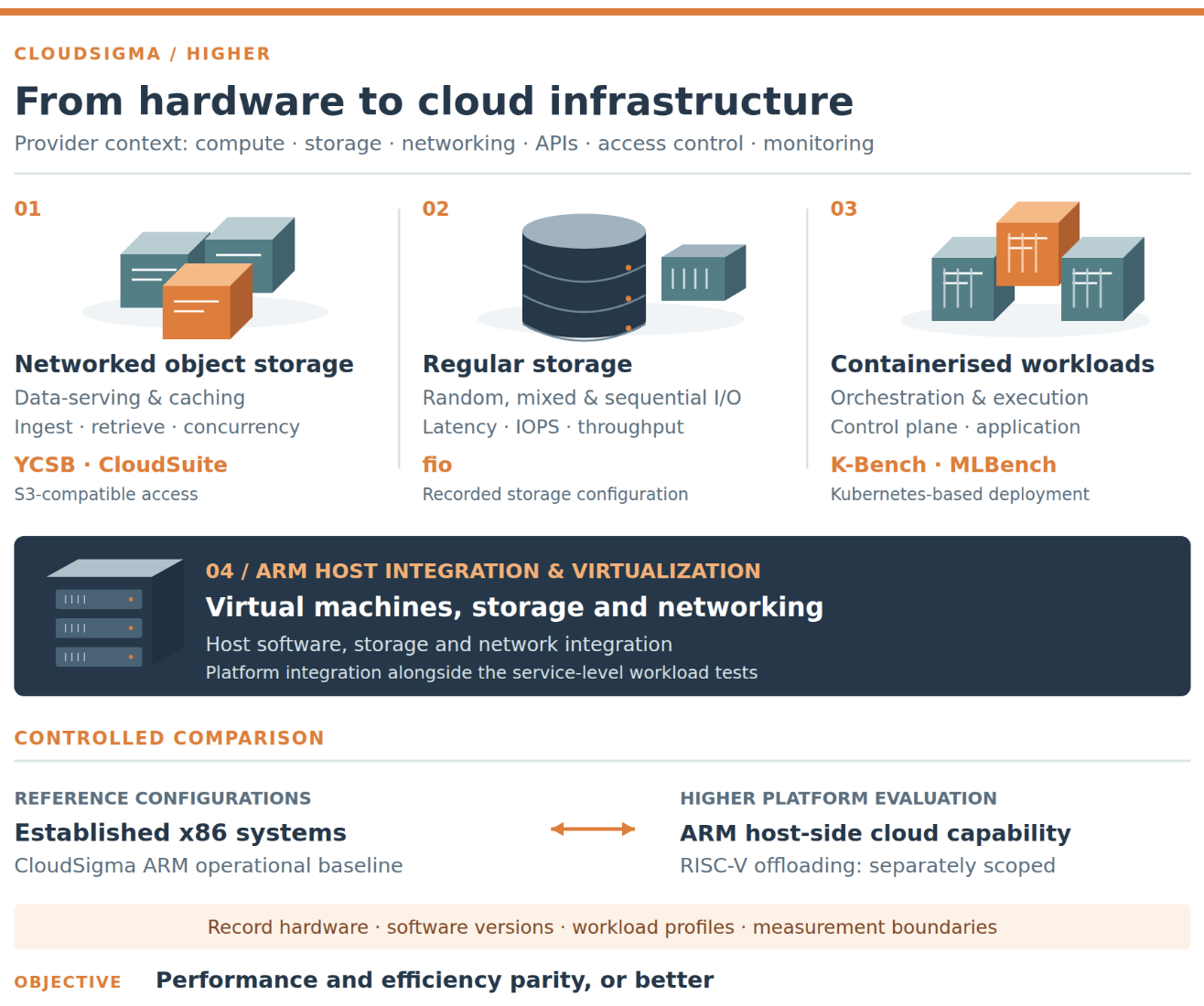
Figure 1. CloudSigma’s IaaS evaluation covers four areas: networked object storage, regular storage, containerized workloads and ARM host virtualization. Controlled comparisons use documented reference systems; host execution and accelerator offloading are recorded separately.
Four areas of platform evaluation
CloudSigma’s IaaS evaluation brings together four areas of work, covering cloud-service workloads and the ARM host platform that supports them.
Networked object storage. How quickly can a service ingest and retrieve data? YCSB and CloudSuite’s data-serving and data-caching workloads provide test profiles. The requirements call for Kubernetes compatibility and an Amazon S3-compatible API, keeping access familiar to application developers. MinIO is one option for object storage; memcached and optimized key/value stores address other data serving and caching needs. Each serves a different purpose within the evaluation.
Regular storage. CloudSigma already uses fio to validate storage clusters. For HIGHER, the tests cover read and write latency, random and mixed I/O, and sequential throughput. Both small requests and sustained transfers matter: good results for one do not guarantee good results for the other. Existing x86 results provide reference points, with the storage hardware and test settings recorded alongside them.
Containerized workloads. Kubernetes provides a way to deploy and manage user-developed services, including those that use networked object storage. K-Bench tests Kubernetes control-plane and data-plane behaviour, while MLBench adds a distributed machine-learning workload. Together, they cover both workload management and application performance.
ARM virtualization. CloudSigma is integrating the ARM host stack needed to run virtual machines and connect them to storage and networking. This work evaluates the platform as infrastructure a cloud provider can operate, alongside the service-level workload tests. Accelerator integration also raises the question of how virtualized workloads can access the device.
Together, these four areas connect hardware capabilities to the services a cloud needs to deliver. Each benchmark will be used where it makes sense for the platform being evaluated.
Integrating hosts and accelerators
HIGHER combines ARM-based host processing and RISC-V acceleration as complementary parts of a heterogeneous computing platform. The host provides the operating-system, virtualization, storage and networking environment, while applications offload selected computation through the accelerator’s driver and runtime. CloudSigma’s work connects these capabilities to the deployment and operation of cloud services.
Virtualization is part of that integration. A PCIe accelerator could be assigned directly to a virtual machine through passthrough, allowing applications in the guest to use it. Assessing this route means checking the host’s device-assignment capabilities, device isolation and the availability of compatible guest drivers and runtimes.
The evaluation will consider both the host platform and supported accelerated workloads, with end-to-end performance and efficiency measured against documented reference configurations. Recording where computation runs and how data moves between host and device will help explain the results in terms of the service as a whole.
Keeping comparisons reproducible
CloudSigma’s existing ARM infrastructure provides an operational baseline, while established x86 environments offer further reference configurations, including storage results. These let us prepare deployments and tests before evaluating them on HIGHER hardware.
Making those comparisons useful means recording what was tested: processor and memory configuration, operating system and kernel, storage and networking, container runtime, Kubernetes version and benchmark settings. For storage, object sizes, access patterns and the number of concurrent requests matter too.
What each measurement covers matters just as much. Object accesses per core, the runtime of a complete service and the performance or energy use of a host-plus-accelerator system answer different questions. Keeping those distinctions visible helps us identify genuine improvements, rather than differences caused by a changed configuration or workload.
What comes next
The initial work has established an ARM baseline, repeatable workload profiles and deployment procedures. The next step is to integrate and run the supported workloads on HIGHER platforms, then compare the results with the reference systems.
Within WP5, this work sits alongside the Platform as a Service (PaaS) and application use cases. CloudSigma brings the provider’s view: what does it take to operate the technology as infrastructure that other services can rely on? The result will be a clear picture for cloud providers: which services HIGHER can support, how their performance compares with established systems, and what work remains before wider adoption.