
A central objective of the HIGHER project is not only to develop new open hardware and software technologies, but also to demonstrate how these technologies can support realistic computing environments and workloads.
To achieve this, the project brings together four complementary use cases covering different layers of the computing stack: Infrastructure as a Service (IaaS), Platform as a Service (PaaS), Accelerated data processing and analytics, and remote CXL-based disaggregated memory. Together, they provide a path from the underlying HIGHER hardware and operating-system environment to complete applications and services, while also exploring emerging capabilities such as cloud-to-edge computing.
Expected contributions from the four use-cases
During the initial phase of this work, teams have focused on establishing the environments, software stacks, workloads and validation methodologies needed to implement and evaluate the use cases. These activities provide the foundation for the more extensive performance evaluation and hardware-based validation planned for the following stages.
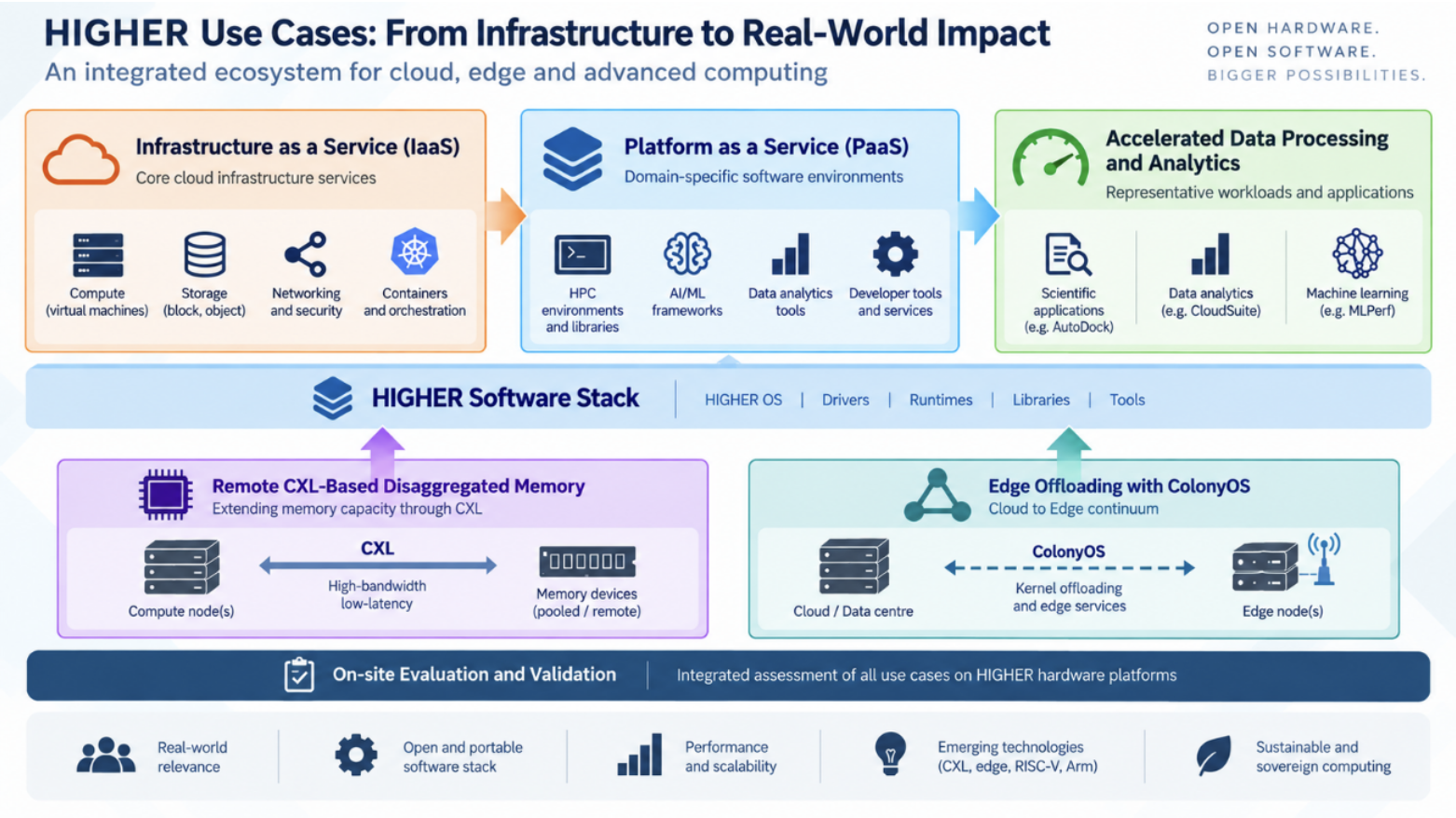
Figure 1: HIGHER use cases from infrastructure to real-world impact.
The four use cases are designed to complement and build on one another rather than operating as independent demonstrations (see Figure 1). At the infrastructure level, the IaaS use case establishes the fundamental services required to operate computing resources in a cloud environment. These include virtual machines, storage, networking, containers and orchestration. The objective is to understand whether HIGHER-based ARM and RISC-V server platforms can support the operational requirements of a real cloud infrastructure and provide a meaningful alternative to conventional x86-based environments.
Building on this infrastructure, the PaaS use case addresses the next layer of the stack: providing ready-to-use software environments in which applications can be developed, deployed, monitored and executed. This includes domain-specific environments for areas such as HPC and machine learning, together with automation and monitoring capabilities. The approach is intended to make the underlying infrastructure easier to use while providing the libraries, tools and runtime components required by different classes of workloads.
With these infrastructure and platform layers in place, the accelerated data processing and analytics use case brings the technology closer to real applications. It uses representative workloads to investigate the performance potential of the underlying HIGHER platforms, including scientific applications such as AutoDock, data-intensive workloads from CloudSuite, and machine-learning benchmarks from MLPerf. This provides a direct link between the capabilities of the HIGHER platform and the performance experienced by real applications.
A complementary dimension is provided by the remote CXL-based disaggregated memory use case. Rather than extending the software stack vertically from infrastructure to applications, this activity explores a system-level capability that can benefit the whole computing environment: making additional memory available to compute nodes through a remotely accessible CXL memory pool. The work also addresses the safeguards needed to ensure that memory accesses remain within the regions allocated to individual hosts or processes.
This overall structure can be viewed as a progression from infrastructure, through platforms, to applications, with the HIGHER software stack providing the common foundation and CXL-based memory extending the capabilities of the underlying systems.
Beyond the limits of HIGHER
Beyond the four main use cases, the project also provides an opportunity to explore how the HIGHER software ecosystem can support emerging deployment models that extend beyond conventional cloud and data-centre environments. One direction being considered is the use of ColonyOS to enable applications to offload selected computational kernels or services towards edge resources. In this scenario, the application does not necessarily execute entirely within a central cloud or data centre. Instead, the HIGHER environment can participate in a cloud-to-edge continuum, allowing selected computation to be moved closer to where it is needed.
At this stage, this activity is being considered as an additional objective of the work package and will be developed as the underlying software and hardware environments mature.
Preparing the Ground for Validation
The work carried out so far builds on the teams’ earlier contributions to the project’s requirements, refinement and specification activities, which helped define the use cases and establish the hardware and software foundations for their implementation and validation. In parallel, the teams have already identified and gathered representative workloads for the different use cases and started executing initial experiments on available reference platforms. These early experiments provide valuable baselines and help assess the readiness of the software environments and toolchains. They also help identify areas requiring further optimization before the workloads are transferred to the HIGHER prototypes.
In the short and medium term, the work will progressively move from this preparation and initial validation phase towards execution on HIGHER hardware platforms. The IaaS activities will extend the validation to HIGHER ARM and server-class RISC-V systems; the PaaS environment will continue to improve automation, monitoring and domain-specific support; and the representative application workloads will be further optimized and evaluated on emerging architectures. In parallel, the CXL-based disaggregated memory use case will evolve from the current software and FPGA-based emulation environments towards evaluation on the dedicated hardware platform as it becomes available.
This progressive approach will allow the teams to build on the experience and results obtained with the current reference platforms, while ensuring that the validation methodology and software environments are ready to take full advantage of the HIGHER prototypes.